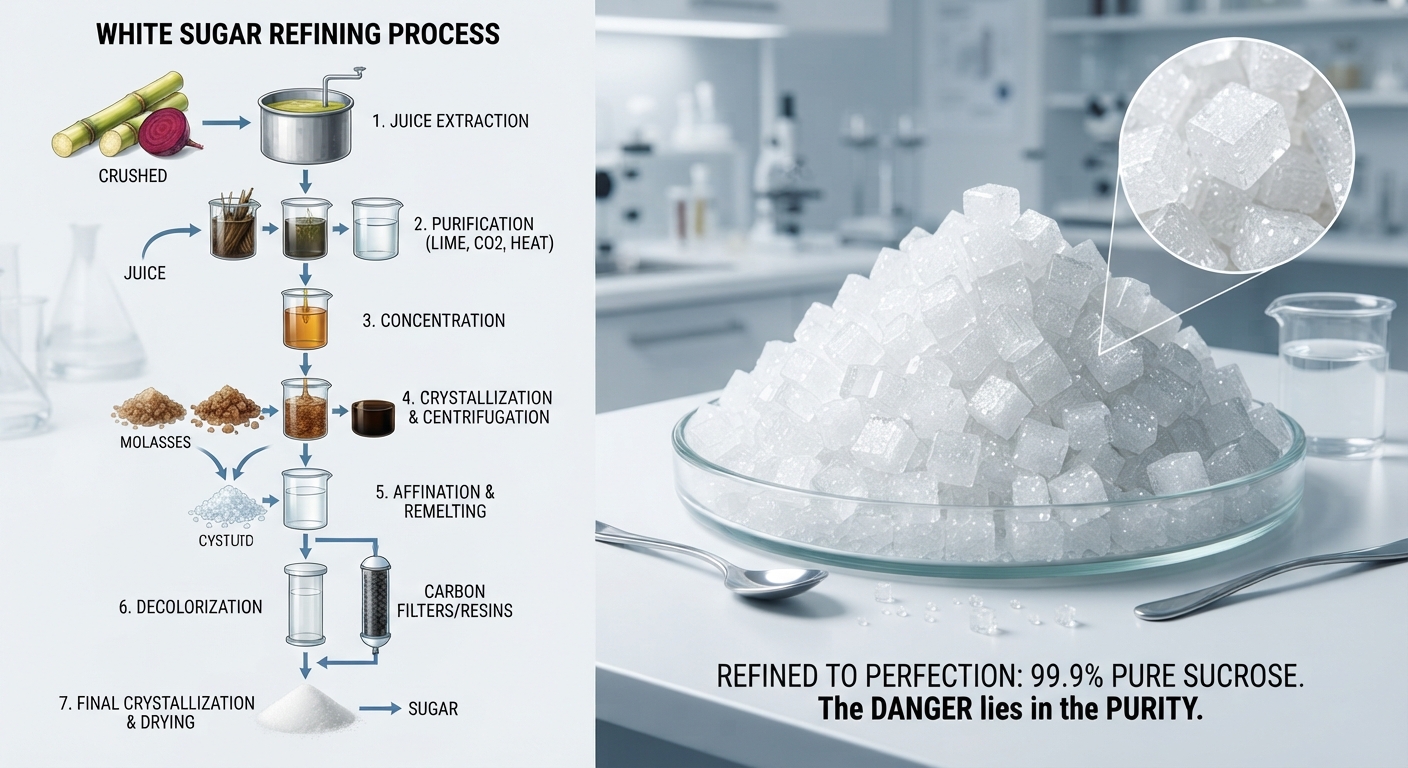
Why white sugar is dangerous? Because it is pure sugar!
When I found out how dangerous white sugar is, I started using raw, unrefined brown sugar, especially in my favorite drink: coffee.
In short, why is white sugar dangerous? Because it is overly pure, and sometimes the refining process can introduce issues due to how long and complex it is.
Let’s take a look at what it consists of.How many stages does white sugar refining have?
About 6 to 7 chemical and physical processes:
Juice extraction: Sugarcane is crushed and pressed, or sugar beets are sliced into thin strips and immersed in hot water to extract raw sugar juice.
Purification (clarification): Milk of lime (calcium hydroxide) and $\text{CO}_2$ are added to precipitate organic impurities, minerals, and fibers; then, the liquid is filtered to obtain a clear juice.
Concentration (evaporation): The juice is boiled under a vacuum to remove the remaining water, resulting in a thick syrup.First crystallization and centrifugation: The syrup is concentrated further until the first crystals form.
A centrifuge then separates the crystals from the liquid molasses, producing raw sugar.
Up to this point, there isn't much to worry about.
Then come three more steps:
Affination and remelting: The raw crystals are washed to remove the outer layer of molasses and then dissolved again in hot water to form a purer syrup.
Decolorization: This syrup is passed through carbon filters (which can theoretically release trace carbon particles), making the liquid transparent.
Final crystallization and drying: The syrup is crystallized again under a vacuum, centrifuged, washed with steam, and finally dried with hot air.
Again, up to here nothing seems particularly bad, so where do the problems with refined sugar lie?
Here is what happens:
1. Chemical Processing Aids and Trace Residues
Food-safety agencies strictly regulate the chemicals used during purification and decolorization, so finished white sugar is 99.9% pure sucrose.
Still, specific substances used in the pipeline carry theoretical or historical concerns:Sulfur Dioxide ($\text{SO}_2$) and Sulfites: In certain "plantation white" sugar processes (common in some developing regions, though rare in modern European and US refineries), sulfur dioxide gas is bubbled through the juice to bleach it (sulfitation).
If not properly washed out, trace sulfites can remain, potentially triggering asthma or allergic reactions in sensitive individuals.
Polyacrylamides (Flocculants): During the clarification stage (Step 2), synthetic polymers like polyacrylamides are often added to bind impurities together so they settle faster.
While polyacrylamide itself is non-toxic, trace amounts of its monomer, acrylamide (a neurotoxin and probable carcinogen), are strictly capped by food-safety limits in the final product.
Lime and Carbon Dioxide / Phosphoric Acid: Calcium hydroxide (milk of lime), carbon dioxide, and phosphoric acid are used to precipitate impurities. These form insoluble calcium carbonate or calcium phosphate sludge ("mud"), which is filtered out.
They do not remain in the crystal lattice of the sugar in hazardous amounts.
Ion-Exchange Resins and Activated Carbon: Modern decolorization (Step 6) relies on physical adsorption (activated carbon) or synthetic polymer beads (ion-exchange resins) regenerated with brine (salt) or mild acids/bases.
Because these are solid filtration media rather than dissolved additives, they do not chemically alter the sucrose molecule, though poorly maintained resins could theoretically leach trace organic compounds.
2. Indirect Byproducts and ContaminantsPesticide and Herbicide Residues: Sugarcane and sugar beets are treated with agricultural chemicals (like glyphosate or atrazine).
However, the multi-stage crystallization and washing process is one of the most aggressive purification methods in food manufacturing—repeated crystallization rejects almost all non-sucrose molecules into the molasses, meaning white sugar actually has far lower pesticide residues than unrefined sugars or molasses.
Bone Char (Ethical/Dietary, not Chemical): Historically, and in some current cane refineries (especially in North America, rarely in Europe), activated carbon made from charred cattle bones is used for decolorization.
It poses no chemical toxicity risk—and no bone particles enter the sugar—but it is a concern for vegans and certain religious diets.
3. The Real Risk: Nutritional Stripping and Metabolic Load
From a toxicological standpoint, industrial refining does not "poison" the sugar; rather, it purifies it too effectively:
Removal of Protective Cofactors: Unrefined cane juice contains trace polyphenols, antioxidants, potassium, magnesium, and chromium.
Refining strips 100% of these micronutrients away, leaving isolated sucrose.
Rapid Absorption and Fructose Load: Because sucrose is 50% glucose and 50% fructose with zero fiber or protein matrix to slow digestion, it hits the bloodstream rapidly.
Chronic excess intake drives hepatic de novo lipogenesis (converting excess fructose into liver fat), insulin resistance, systemic inflammation, and dental caries—none of which require chemical contaminants to cause harm.In short, the chemical agents used in refining are largely filtered out along with the molasses, leaving a molecule that is chemically clean—and it is precisely that extreme chemical purity and high concentration of isolated sucrose that makes it metabolically harmful when overconsumed.
So, while there is a minor risk of chemical contaminants, the real danger of white sugar is that it is too pure! Incredible, isn't it?
How many people would have told you something so simple? It is literally its purity that makes it dangerous!
--
The information presented in this story reflects the author’s personal experience or is drawn from archival material; it is not supported by universal clinical evidence.
The effectiveness of any product suggested in this article is not a substitute for conventional medical treatments.
For official health guidelines, please consult a qualified physician.